Most PFAS treatment conversations eventually arrive at the same shortlist of technologies: granular activated carbon, ion exchange, reverse osmosis, and a growing number of emerging approaches.
The harder question is which treatment approach actually fits the application.
That question matters more than it might seem. PFAS contamination shows up in municipal drinking water systems, industrial wastewater streams, groundwater remediation projects, and process water applications, and the treatment realities across those environments can differ significantly. A municipal utility facing a compliance deadline is working through a different set of constraints than an industrial facility managing variable chemistry, co-contaminants, and production-driven operating requirements.
PFAS treatment is rarely a simple technology purchase. It is a system selection problem that depends on understanding the application before settling on an approach.
This article covers the major PFAS treatment technologies in use today, how municipal and industrial applications differ in practice, and what drives successful treatment system selection.
Why PFAS Treatment Is Different
PFAS has created a treatment challenge unlike most conventional contaminants, and not just because of the chemistry.
The EPA’s 2024 rule established enforceable Maximum Contaminant Levels for six PFAS compounds, with limits as low as 4 parts per trillion for PFOA and PFOS. Many utilities and facilities are now under active pressure to achieve compliance on compressed timelines, often without the luxury of extended evaluation periods. That regulatory urgency changes how treatment decisions get made in practice.
It also matters to understand what most commercially deployed PFAS treatment technologies actually do. Many remove or separate contaminants from the water stream rather than eliminating them. Granular activated carbon captures PFAS onto media. Ion exchange transfers contaminants onto resin. Reverse osmosis concentrates contaminants into a reject stream. In each case the water gets cleaner, but the contaminant management challenge shifts rather than disappears.
That reality extends the treatment conversation well beyond removal performance. What happens to spent media? Where does the concentrate go? What downstream management pathway exists for residuals? Those questions are as much a part of system selection as removal efficiency, and facilities that don’t address them early often encounter them as operational problems later.
Comparing Major PFAS Treatment Technologies
Granular Activated Carbon
Granular activated carbon is the most established PFAS treatment approach in municipal drinking water applications, and for good reason. GAC has a long deployment history, a well-understood operating model, and established implementation pathways that fit naturally into many existing treatment infrastructure frameworks.
For utilities prioritizing proven technology, operational familiarity, and predictable long-term maintenance, GAC often enters the conversation first. It performs strongly against many long-chain PFAS compounds including PFOA and PFOS, which are among the most regulated.
The suitability question gets more nuanced with shorter-chain PFAS. Compounds like PFBS and PFBA adsorb less strongly onto activated carbon, which can influence breakthrough behavior, media replacement frequency, and overall treatment performance. Water chemistry, organic loading, and empty bed contact time all influence how a GAC system performs against a specific PFAS mixture, which is why application-specific evaluation matters rather than assuming the technology will behave consistently across different source waters.
Ion Exchange
Ion exchange has gained significant traction in PFAS treatment programs, particularly where compact footprint, short-chain PFAS performance, or faster adsorption kinetics are priorities.
Compared with GAC, ion exchange resins can offer stronger performance across certain short-chain PFAS compounds and a smaller physical footprint, which matters considerably in retrofit situations where space is constrained. In practice, those characteristics can shift the technology decision in ways that pure removal performance comparisons don’t fully capture.
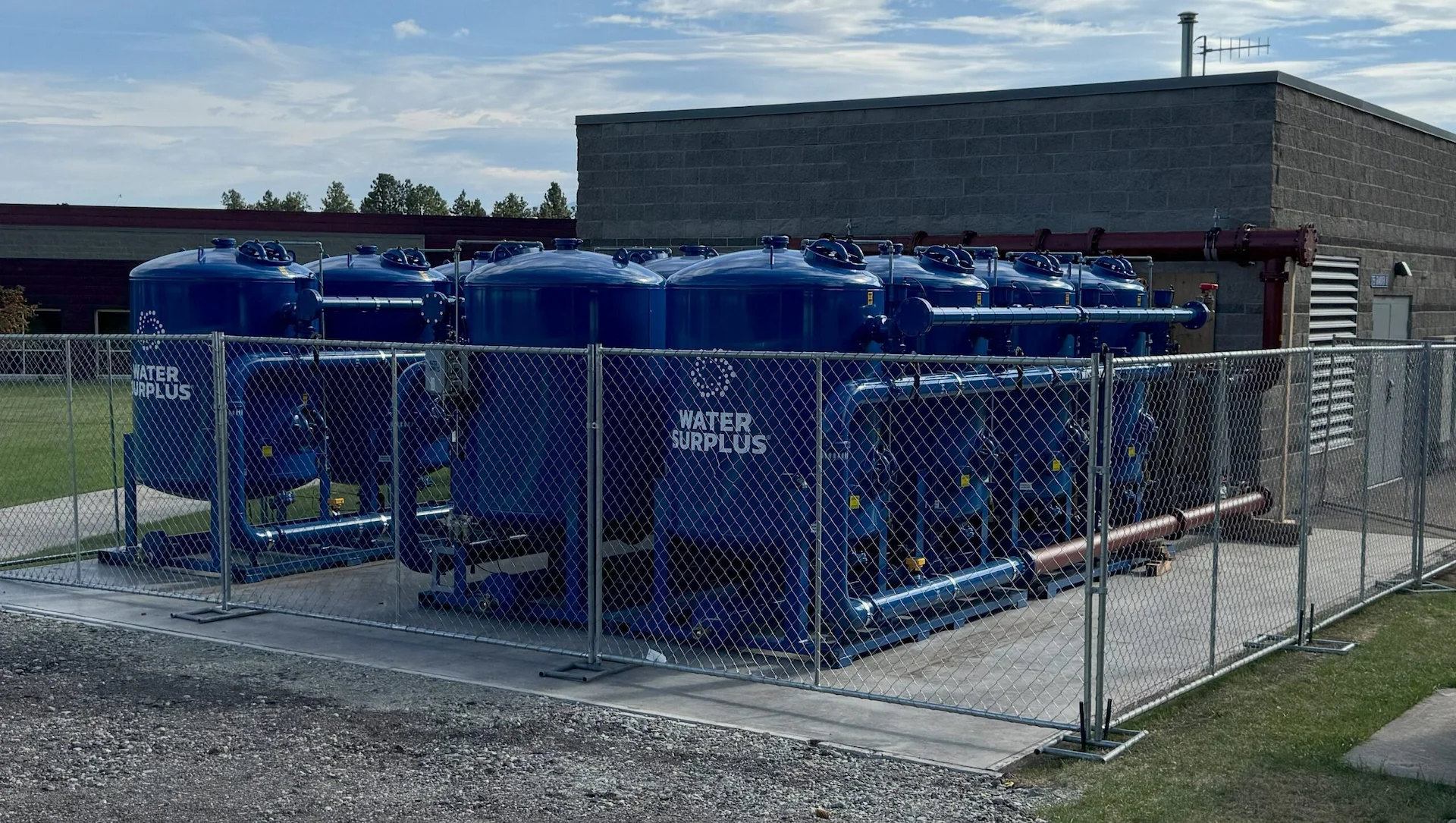
When the City of Kalispell detected PFAS levels twice the EPA limit in 2024 and needed a fast, effective solution, WaterSurplus deployed anion exchange resin-based systems that achieved non-detectable PFAS levels with a significantly smaller footprint than a GAC system would have required for the same application.
Resin selection, competing contaminants, pretreatment requirements, exhaustion behavior, and residual management all influence whether ion exchange is the right fit for a specific site.
Reverse Osmosis and Membrane Treatment
Reverse osmosis follows a different treatment model entirely. Rather than adsorbing PFAS onto a media bed, membrane systems physically separate contaminants from the water stream through pressure-driven filtration. RO can achieve strong rejection across a broad range of PFAS compounds while simultaneously reducing other dissolved constituents. That makes it particularly relevant where PFAS treatment intersects with broader water quality objectives.
That broader treatment capability is one reason RO appears more frequently in industrial, reuse, and complex chemistry applications than in straightforward municipal drinking water compliance projects. Industrial facilities managing PFAS alongside high total dissolved solids, elevated contaminant loading, or process water reuse loops often find that membrane treatment addresses multiple objectives in a single step.
The tradeoffs are real. Pretreatment requirements, energy demand, and concentrate management add complexity and operating cost. Because membrane systems separate rather than destroy contaminants, the concentrate stream requires its own downstream management pathway. That consideration belongs in the evaluation from the start, not as an afterthought once the system is installed.
Those tradeoffs haven’t stopped municipalities from turning to RO where the application calls for it. In 2026, WaterSurplus commissioned a 580-GPM ImpactRO™ system for the City of Prescott, Wisconsin, one of the first reverse osmosis systems deployed in a Wisconsin municipal water treatment application. Prescott faced a combination of PFAS, nitrate, and hardness challenges that made RO’s broad-spectrum treatment capability a natural fit. The system achieves up to 90% water recovery, and concentrate management is built into the treatment approach from the outset. As Jim Groose, Senior Vice President of Municipal Water Treatment at WaterSurplus, explained: “Historically, most municipalities couldn’t justify using RO because traditional systems wasted 20–30% of the water they treated. With ImpactRO, that equation finally changes, making RO economically feasible for many municipalities for the first time.”
Municipal vs Industrial PFAS Treatment Considerations
Municipal and industrial PFAS projects may evaluate many of the same technologies, but the decision framework often differs in meaningful ways.
Municipal drinking water systems are typically working against a compliance clock. The 2024 EPA MCLs created enforceable thresholds that public water systems must meet, and many utilities are managing that pressure while maintaining full-capacity operation for their communities. In that environment, proven treatment performance, operational simplicity, and long-term lifecycle reliability drive technology selection.
Deployment strategy can matter almost as much as technology selection in these situations. Utilities facing compressed compliance timelines often need interim treatment approaches that maintain compliant operation while permanent infrastructure is engineered, permitted, and constructed. That rental-to-permanent pathway has become an important part of how municipal PFAS response actually works in practice.
WaterSurplus installed Wisconsin’s first three PFAS removal systems approved by the state DNR, deploying anion exchange resin-based rental systems that went online in 2022 and 2023. As Michael Heyroth, Utility Director at Rib Mountain Sanitary District, put it: “The WaterSurplus system allows us to deliver safe, clean water treated to non-detectable PFAS levels now, while we wait for the design and manufacture of a full-scale treatment plant.”
Industrial applications present a broader operating landscape. A facility managing PFAS in process water or wastewater is often dealing with more variable chemistry, higher contaminant loading, competing dissolved constituents, and treatment objectives that extend beyond PFAS alone.
Production schedules, existing treatment infrastructure, discharge permit requirements, and reuse goals all shape what a workable system looks like. In those environments the technology selection framework shifts toward application-specific evaluation, and membrane-based approaches or multi-treatment-step strategies may become stronger candidates.
The practical distinction is not that one technology suits municipal and another suits industrial. It is that the priorities, constraints, and operating environments are different enough that the same technology comparison yields different answers depending on the site.

Residuals, Concentrate, and the Full Treatment Lifecycle
One of the most important realities in PFAS treatment often gets less attention than removal performance: treatment does not end the management challenge. It relocates it.
GAC eventually requires media replacement or regeneration, while ion exchange systems generate spent resin that must be handled, transported, and either regenerated or disposed of through approved pathways. Reverse osmosis produces concentrate streams with elevated contaminant loading that need their own downstream management strategy. In each case, what leaves the treated water stream has to go somewhere.
In practical project design, residual management planning tends to surface early rather than late. The downstream pathway for spent media or concentrate influences technology selection, system sizing, site logistics, and lifecycle cost in ways that aren’t always visible when the evaluation starts with removal efficiency alone.
Destruction technologies are an emerging option for closing this loop. Approaches such as high-temperature incineration, supercritical water oxidation, and electrochemical oxidation can break down PFAS compounds rather than simply concentrating or transferring them. Most are not yet deployed at a broad commercial scale for water treatment residuals, but they are an active area of development and an increasingly relevant consideration for facilities and utilities thinking about long-term treatment strategy.
PFAS Treatment: More Than a Technology Decision
PFAS treatment system selection is rarely straightforward, and the shortlist of available technologies doesn’t simplify it as much as it might appear to.
Granular activated carbon, ion exchange, and reverse osmosis each have meaningful roles to play depending on the application, contaminant profile, water chemistry, and operational constraints involved. Feedwater chemistry, footprint constraints, permitting realities, deployment timing, operator familiarity, and downstream residual management frequently shape the feasible solution set in ways that a pure technology comparison doesn’t capture.
For municipal utilities and industrial facilities alike, the strongest PFAS treatment decisions tend to start with the application rather than the technology. That means understanding regulatory obligations, operational constraints, residual management realities, and long-term treatment strategy before settling on an approach.
If you’re evaluating PFAS treatment options for a municipal or industrial application, WaterSurplus’s engineering team can help assess treatment strategy, technology fit, and system considerations for your specific operating environment.
Frequently Asked Questions
What is the most effective PFAS treatment technology?
There is no single best PFAS treatment technology. Granular activated carbon, ion exchange, and reverse osmosis each offer advantages depending on PFAS profile, water chemistry, treatment objectives, and operating conditions. The right approach depends on the specific application.
How do GAC, ion exchange, and reverse osmosis compare for PFAS treatment?
GAC and ion exchange remove PFAS through adsorption onto media or resin, while reverse osmosis physically separates contaminants from the treated water stream through pressure-driven filtration. Each involves different tradeoffs in performance, footprint, pretreatment requirements, operating costs, and residual management.
Is reverse osmosis effective for PFAS removal?
RO can achieve strong PFAS rejection across many compounds while also reducing additional dissolved contaminants. It tends to be most relevant in industrial, reuse, or complex chemistry applications where broader water quality objectives exist alongside PFAS removal. Concentrate management is an important part of any RO-based PFAS treatment evaluation.
What factors influence PFAS treatment system selection?
Key variables include contaminant profile, feedwater chemistry, flow requirements, treatment objectives, regulatory drivers, infrastructure constraints, lifecycle operating costs, and residual management strategy.
Are PFAS treatment systems different for municipal and industrial applications?
Often yes. Municipal systems typically prioritize regulatory compliance, operational simplicity, and long-term lifecycle performance. Industrial applications may involve more complex chemistry, variable operating conditions, and broader treatment objectives that influence technology selection differently.
Do PFAS treatment systems destroy PFAS contaminants?
Most commercially deployed systems remove or separate rather than destroy PFAS. GAC captures contaminants onto media, ion exchange transfers them onto resin, and RO concentrates them into a reject stream. Destruction technologies are an active area of development but are not yet widely deployed at commercial scale for water treatment residuals.
What is the first step in evaluating a PFAS treatment system?
Most evaluations begin with understanding the application: PFAS profile, water chemistry, treatment objectives, flow requirements, operating constraints, and downstream management considerations. Site characterization and engineering review are typically important early steps.
Can a temporary PFAS treatment system be deployed while a permanent solution is built?
Yes. Rental or temporary treatment systems can be deployed relatively quickly to achieve compliant operation while permanent infrastructure is engineered, permitted, and constructed. This approach is increasingly common among municipal utilities managing compliance timelines that don’t align with the time required to design and build a full-scale treatment facility.
Search
Recent Posts
- Reliable Iron and Manganese Removal for Municipal and Industrial Water
- Common Causes of Reverse Osmosis System Fouling and How to Prevent It
- Mobile Water Treatment Systems: Industrial & Municipal Use Cases
- PFAS Treatment Systems: Key Considerations for Municipal and Industrial Applications
- High-Recovery Reverse Osmosis Systems: Reducing Wastewater and Operating Costs
Categories
- Brand Posts
- Engineering Posts
- Environmental Industry Posts
- Fabrication Posts
- Food & Beverage Industry Posts
- Industrial Water & Wastewater Industry Posts
- Industry Posts
- Innovation Posts
- Mining Industry Posts
- Municipal Industry Posts
- News Releases
- Oil & Gas Industry Posts
- Product Posts
- Project Posts
- Rental Posts
- Selling To Us Posts
- Service Posts
- Surplus Posts
- Sustainability Posts
- Team Posts
- Technology Posts
- Water Reuse Industry Posts
