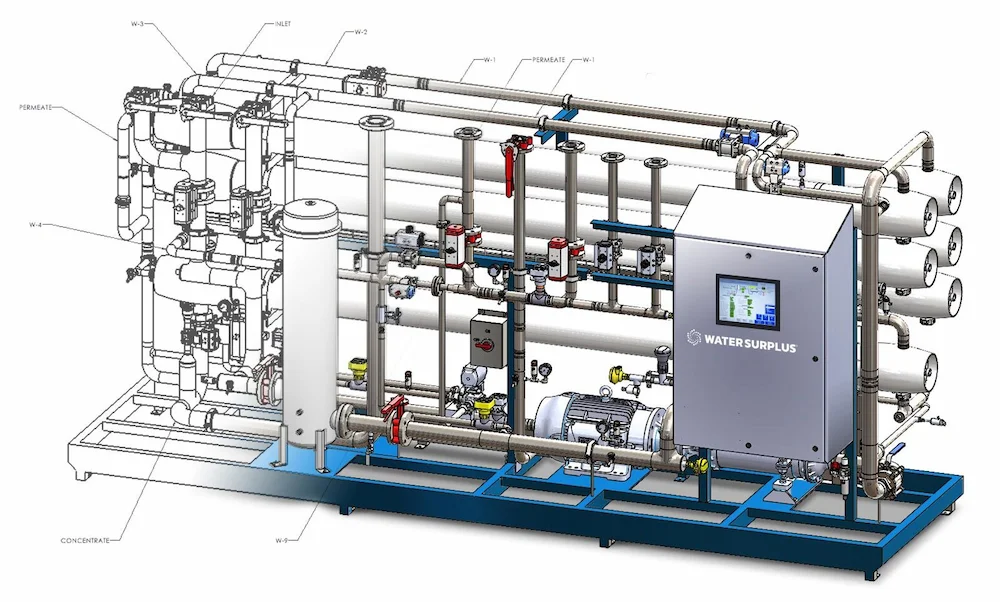
If your facility runs a conventional reverse osmosis (RO) system, a significant portion of your feedwater is leaving as waste. That’s not an accident. It’s by design.
Most industrial RO systems are deliberately engineered around conservative recovery targets. That’s not a flaw. It’s a reliability decision. Wide scaling margins, conservative operating windows, and predictable long-term performance were the priorities when many of these systems were designed and installed. For a long time, that tradeoff made sense.
But water costs are rising, discharge requirements are tightening, and reuse and efficiency targets are becoming harder to ignore. The gap between what a conventional system recovers and what a well-designed high-recovery system can achieve is significant. Conventional systems typically operate at 50–75% recovery while high-recovery designs may reach 85–95% or higher in suitable applications, representing a real operational and economic opportunity for facilities willing to take a closer look.
This article covers what high-recovery RO actually involves, where it delivers the most value, and what determines whether it’s the right move for your application.
Why Conventional RO Systems Leave Recovery on the Table
The reason most conventional RO systems don’t push for higher recovery isn’t a lack of capability. It’s a chemistry problem.
As recovery increases, dissolved solids that don’t pass through the membrane become progressively more concentrated in the reject stream. Past certain thresholds, compounds like calcium carbonate, calcium sulfate, and silica can begin depositing on membrane surfaces. This can lead to fouling, scaling, declining performance, and more frequent cleaning cycles. Designing around those limits is how conventional systems end up at 50–75% recovery. It’s the range where long-term reliability is easiest to maintain.
The cost of that tradeoff can be significant. More feedwater in means more reject out. For facilities managing discharge restrictions, rising wastewater costs, reuse objectives, or constrained water supply, that volume adds up, and so do the costs.
How High-Recovery RO Systems Improve Water Utilization
Getting to higher recovery isn’t a matter of turning a dial. It requires rethinking how the system is configured, how pretreatment is designed, and how the system is monitored and controlled over time.
How Higher Recovery Is Actually Achieved
Higher recovery typically involves one or more of the following system design approaches. Staged recovery systems distribute treatment across multiple membrane stages to improve water extraction while maintaining tighter control over concentrate conditions. Some facilities use Closed-Circuit Reverse Osmosis (CCRO) or batch-style approaches, which recirculate concentrate through controlled cycles rather than relying on conventional continuous-flow operation.
It’s also worth noting that higher recovery doesn’t always require a purpose-built system from the outset. For facilities with existing conventional RO installations, adding a secondary concentrate RO stage can be a practical, cost-effective path to meaningfully improved recovery without full system replacement. The right approach depends on existing infrastructure, feedwater characteristics, and long-term operating goals.
WaterSurplus’s ImpactRO takes this further, using a high-recovery RO system design that distributes hydraulic load more evenly across the membrane train, reducing the fouling stress in later stages that typically forces a tradeoff between recovery and membrane life. Micro-disruption strategies further limit foulant accumulation during normal operation, supporting higher sustained recovery without sacrificing stability or membrane performance.
Fouling, Scaling, and Pretreatment Management
Push recovery higher and chemistry management becomes the critical variable. Higher concentration ratios place greater demands on feedwater characterization, pretreatment design, antiscalant programs, and particulate control. In high-recovery applications, pretreatment is often the primary enabler of performance, not a secondary consideration. Depending on feedwater conditions, strategies may need to address hardness, alkalinity, suspended solids, organics, silica loading, and pH-dependent scaling behavior.
Membrane surface characteristics also influence performance. WaterSurplus’s NanoStack membrane coating is designed to reduce fouling adhesion at the membrane surface, meaning membranes foul more slowly and are easier to clean when fouling does occur. In high-recovery environments where fouling pressure is inherently higher, that combination of resistance and cleanability directly supports sustained performance over time.
Monitoring and Controls
Higher recovery also leaves less operational margin for error. Differential pressure trends, conductivity performance, recovery behavior, and cleaning frequency patterns all serve as early indicators of developing fouling or scaling issues. Modern automation and controls help facilities stay ahead of problems before they escalate into efficiency losses or unplanned downtime.
WaterSurplus’s NanoScope platform extends this by monitoring at the membrane level directly, helping operators identify developing issues earlier than conventional system-level indicators allow.
Reducing Wastewater and Concentrate Disposal Costs
For many facilities, wastewater reduction is the most immediate reason to evaluate high-recovery RO. Every percentage point of recovery that stays on the table is reject volume that has to go somewhere, whether that’s sewer discharge charges, hauling costs, wastewater treatment, or compliance obligations.
By recovering more usable water from the same feedwater source, high-recovery systems reduce that concentrate burden directly. The impact is most significant in industrial reuse projects, facilities facing discharge limitations, and operations working toward reduced wastewater footprints.
High-recovery RO also plays a key role in Zero Liquid Discharge (ZLD) and near-ZLD treatment strategies. By reducing liquid volume before downstream treatment processes, high-recovery systems lower the overall cost and complexity of achieving minimal discharge. For facilities evaluating discharge minimization, that progression from conventional RO to high-recovery RO to broader ZLD design is often where the most significant gains are found.
The Impact of Higher Recovery on Operating Costs
The cost conversation doesn’t stop at wastewater. Higher recovery means more usable water produced from the same feedwater source. That reduces raw water demand, purchased water consumption, and dependence on constrained supply sources.
That said, it’s worth being direct about the tradeoffs. Energy demand, chemical consumption, cleaning frequency, pretreatment burden, and membrane replacement intervals all factor into lifecycle operating costs. As concentration increases, systems may operate under elevated pressure conditions. Modern designs address this through optimized hydraulic configuration, staged recovery approaches, and energy recovery devices where appropriate. Higher recovery does not automatically mean lower operating cost. The goal is optimized lifecycle performance that balances water utilization, wastewater reduction, efficiency, and long-term reliability.
Field deployment data helps illustrate how these economics can play out in practice. A multi-year pilot at Orange County Water District’s Groundwater Replenishment System, the world’s largest advanced water purification facility for potable reuse, demonstrated that NanoStack membrane coatings reduced clean-in-place requirements by more than half and lowered RO energy consumption by more than 15%, with an estimated payback period of under two years. OCWD subsequently moved forward with full-scale deployment of 1,050 NanoStack-coated membranes across one complete RO train. Site conditions always influence outcomes, but this gives a real-world reference point for what the economics can look like.
Where High-Recovery RO Provides the Most Value
High-recovery RO isn’t the right fit for every application. But certain environments consistently make strong candidates.
Industrial water reuse systems are among the best fits. These projects prioritize maximizing usable water recovery while minimizing reject generation and reducing freshwater dependence, objectives that align directly with what high-recovery design delivers.
Food and beverage operations manage large process water volumes alongside real wastewater economics. Discharge costs and freshwater procurement together can create a strong business case for improved recovery, and these environments are often well suited to high-recovery implementation with appropriate pretreatment.
Boiler feed and power applications operate under demanding water quality requirements involving conductivity control, silica management, and high reliability expectations. Where high-purity demand intersects with meaningful wastewater economics, recovery optimization becomes particularly relevant.
Municipal and industrial reuse projects facing water scarcity or discharge constraints are increasingly incorporating high-recovery strategies into broader water management programs. The OCWD deployment illustrates the scale at which these technologies are now being adopted in critical reuse infrastructure.
Engineering Considerations for High-Recovery Implementation
The right question isn’t how high recovery can go. It’s what recovery target is technically and economically sustainable for a specific site.
Feedwater chemistry is the primary decision gate. Hardness, alkalinity, silica, dissolved and suspended solids, organic loading, pH behavior, and seasonal variability all influence what’s achievable. A meaningful feasibility assessment begins there. Pretreatment capability becomes increasingly important as recovery targets rise. Facilities should assess whether their monitoring, instrumentation, operational oversight, and maintenance readiness align with the proposed strategy.
Recovery targets must also account for permeate quality requirements. In applications like food and beverage production, pharmaceuticals, or high-purity process water, higher concentration factors can influence product water quality and need to be factored into the design from the start. The appropriate target comes down to balancing water utilization objectives against scaling behavior, fouling risk, operating stability, and lifecycle economics.
Beyond the Recovery Percentage
High-recovery RO is fundamentally about getting more value from the water you’re already treating while reducing what you’re sending to drain. For facilities facing rising water costs, tighter discharge requirements, reuse goals, or constrained supply, the opportunity is real.
But the percentage alone doesn’t tell the whole story. Feedwater chemistry, pretreatment capability, monitoring, system design, and application-specific goals all determine what sustainable high-recovery performance looks like in practice. The difference between a system that performs reliably over the long term and one that trades recovery gains for maintenance burden usually comes down to how well those factors are addressed at the design stage.
If you’re evaluating high-recovery RO for your facility, whether that’s a new system, an upgrade to an existing installation, or part of a broader discharge minimization strategy, WaterSurplus’s engineering team can help you assess what’s achievable for your specific application.
Frequently Asked Questions
What recovery rates can high-recovery RO systems realistically achieve?
Conventional industrial RO systems commonly operate around 50–75% recovery, depending on feedwater chemistry, application conditions, and system configuration. High-recovery strategies may target 85–95% or higher in suitable environments, although achievable performance remains highly application dependent.
Can I improve recovery on my existing RO system without full replacement?
In many cases, yes. Adding a secondary concentrate RO stage to an existing conventional system can be a practical, cost-effective path to meaningfully improved recovery without full system replacement. The right approach depends on existing infrastructure, feedwater characteristics, and long-term operating goals. A site-specific assessment is usually the best starting point.
What feedwater conditions are most favorable for high-recovery operation?
Feedwater chemistry is one of the primary decision factors. Hardness, alkalinity, silica concentration, TDS levels, suspended solids, organics, pH behavior, and seasonal variability all influence sustainable recovery performance. Lower scaling and fouling potential generally supports more aggressive recovery targets.
How does high-recovery RO relate to Zero Liquid Discharge systems?
High-recovery RO commonly functions as an upstream concentration stage in near-ZLD and ZLD treatment architectures. By reducing liquid volume before downstream thermal or solids-handling processes, high-recovery systems can improve overall discharge minimization strategies.
Does high-recovery RO increase energy consumption?
Higher recovery can increase pressure requirements and influence energy demand. Modern systems may address this through optimized hydraulics, staged configurations, operational controls, and energy recovery devices where appropriate. The overall energy picture depends heavily on system design and operating context.
What is the first step in evaluating a high-recovery RO upgrade?
Most evaluations begin with a site-specific feasibility assessment focused on feedwater characterization, recovery constraints, pretreatment capability, wastewater economics, and long-term operating objectives.
Search
Recent Posts
- Mobile Water Treatment Systems: Industrial & Municipal Use Cases
- PFAS Treatment Systems: Key Considerations for Municipal and Industrial Applications
- High-Recovery Reverse Osmosis Systems: Reducing Wastewater and Operating Costs
- WaterSurplus Joins Kaukauna Utilities Groundbreaking for New ImpactRO Water Treatment System
- WaterSurplus Brings ImpactRO to the Municipal Market
Categories
- Brand Posts
- Engineering Posts
- Environmental Industry Posts
- Fabrication Posts
- Food & Beverage Industry Posts
- Industrial Water & Wastewater Industry Posts
- Industry Posts
- Innovation Posts
- Mining Industry Posts
- Municipal Industry Posts
- News Releases
- Oil & Gas Industry Posts
- Product Posts
- Project Posts
- Rental Posts
- Selling To Us Posts
- Service Posts
- Surplus Posts
- Sustainability Posts
- Team Posts
- Technology Posts
- Water Reuse Industry Posts